Showing posts with label France. Show all posts

Thursday, June 25, 2009

Of Le Art du Vin

To close off my postings about the Loire Valley (you can see how much I adored the region on how many postings I dedicated to it). I would like to dedicate a short posting to the art of wine tasting and wine making. France and wine have become synonymous with each other, with the French perfecting wine making down to an art. They invented the study of viticulture for goodness sakes so they do know a thing or two about wine.

The Loire Valley where I visited are known for their white wine, especially the sparkling variety. The best way to get a wine tour is to sign up with a tour company who will take you to a number of different wineries and allow you to get a tasting at each one. All in the course of one afternoon.

I found myself on a very private tour with just me, a French tour guide, and 2 Canadian ladies (who knew less about wine than I did, which was to some relief).

Wine tasting is a delicate affair, full of unspoken rules.


1) The wine tasting is never free. There is always a fee and if you request a tasting, they are going to expect you to buy a bottle of wine, out of courtesy. Thankfully, as part of the tour group, we were not under any such obligations.

2) When the wine is poured, swill it around the glass to let it breathe. Smell it, take in the aroma of the wine in order to pinpoint all of the notes it contains. Like a perfume, let each layer reach shyly towards you.

3) Swish the wine in your mouth to better savor the many flavors within. Take your time, this is not an event to rush but a privilege to be enjoy. A wine is going to taste different every year since the amount of rainfall or the quality of the dirt will change the flavor of the grapes, give it different qualities that it may lack from previous years. Different flavors of grapes will equal a unique wine that can only be found within that particular year.

4) When you are done savoring the wine, spit (that's what the silver bucket is for). Swallowing is fine if you are not driving and you are only tasting a couple of wines. Swallowing is not fine when you have 10 different wines to taste and prone to getting light-headed from the beverage. I speak from personal (and shameful) experience, though in my defense, the only people who spit out the wine was our French tour guide.

Lastly, the coolest thing that I saw were the storage units for the wines. No warehouses and electric refrigerators in France. Here, nature is the master, and only her own refrigerator will do. The quarries underneath the hillsides are deep, rocky, and absolutely frigid. Perfect for storing that 1873 Chinon Blanc (a real wine too, worth 200 euros, which I saw in person, as well as other 100+ year old wines).


I also found my favorite type of white wine: sparkling. Like champagne but sweeter, it is heaven in a flute glass. A wine so complicated that it takes a month to prepare the newly fermented wine for transport to wine shops (a process that includes tipping the bottle, freezing it, then leaving it for an additional couple of weeks for the shock to settle). The result is the only wine bottle I purchased that day, which I cannot wait to drink.

Wednesday, June 24, 2009

Of Le Jardin

I may have been a bit vague in that last posting about where I was and why and how I got there. Well, let us backtrack. I had always planned on going back to France, if only to visit an authentic French vineyard and participate in a tasting. Lana, one of my travel mates, and I had actually planned to go to Bordeaux - home of French wine - but at the last minute, she decided to take a solo trip to the Isle of Skye, which left me by my lonesome as the only person who wanted to go back to France.

Short of hating myself for the rest of my life for not going back to France, I decided to throw caution to the wind and buy myself a plane ticket to Tours, France in the Loire Valley, recommended by many travel websites for its white wine and chateaux. What commenced was five too-short days traveling completely alone. Why so short? Because any longer and my brother-in-law, the only person in my family who would not kill me for doing this, was the only person who knew.

And because for safety purposes, a 4'11'' Asian girl with a lack of street smarts traveling around for an extended period of time all by herself is a recipe for trouble.

The reasons I wanted to go to the Loire Valley was three-fold: self-examination (ruminated on in the prior post), the wine, and the chateaux, of which there were more than 300 in the valley. Oh to be a rich nobleman in France during the 17th-19th century...or to be his wife...

The first one is the most famous: the Chateau de Chenonceau, out of more than 300 chateaux in the Loire Valley (also known as "Le Jardin de France" because of the rolling green hillsides dotted with beautiful castles).

In the afternoon, I boarded a train from Tours to visit the chateau. Getting off of the train, there was nothing around except for the sound of the birds. Then, I followed a grove of trees which I recognized from so many historical dramas with the main heroine being taken to a secluded mansion in the countryside, hidden by a tree-lined path. That was what I felt like, except my carriage was my two feet and I was trying to look past the trees, to catch my first glimpse of the chateau.


Then, my breath caught in my chest as the trees, like curtains, opened up and presented me with this:


In the late spring sun, with the chirping of the birds all around, I was a lady, calling on the owner. The most beautiful part of the chateau, besides its 3 stories of tapestry filled rooms, where the gardens, filled with the scent of spring roses blooming in every color and arranged in romantic swirling patterns. Everything had that feminine touch of romance, which is no surprise since it was owned by Diane de Poitiers and Catherine de Medici (at different times), who were both involved with French monarchs.


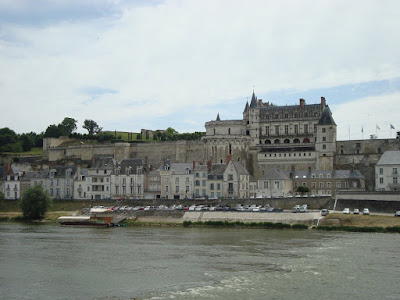
And speaking of monarchs, the next day was the Chateau d'Amboise which I chose as a pilgrimage to the grave of Leonardo da Vinci, who died there. The chateau was located in the town of Amboise and overlooks it like a crown. Prior to coming, I wondered how I was going to be able to find the chateau if it was located in the town. To my surprise, it was not hard to find, as it was my first sight as I crossed the bridge from the train station into the little town of Amboise.


This one belonged to King Francois I. The rooms were a bit simpler than Chenonceau yet elegant all the same, with wooden chairs, decorated pillars, and gargoyles (indicative of a residual Gothic influence).


Afterward, I visited the Chateau du Close Luce, located about a couple of blocks north. This modest house, by royalty standards, here Leonardo spent the last 4 years of his life, at the request of King Francois I, who funded his experiments and art during that time. There was also a tunnel underneath the house that connected it to the Chateau d'Amboise, and where Francois could visit Leonardo whenever he wished.


It is also to this place that Leonardo brought the Mona Lisa when he finished it, not wanting to part with such a unique piece of art. Perhaps that is why the roses grown in the Renaissance-style garden are called Mona Lisa roses.


Visiting these chateaux, filled with so much history and beauty, one can't help but feel a little like royalty. Especially when they are not as well-known as Versailles and as such, you can walk the rooms alone and pretend you are a solitary visitor, a Renaissance noble, calling upon the master of the house. I almost did not want to leave this dream.


The Loire Valley, the photo album

Tuesday, June 23, 2009

Of Le Voyage Sentimental

The wine glass in my hand is cool to the touch. I examine the bubbles that steadily float to the surface, disappearing only to have a myriad of others take their place. I tip the glass. The wine touches my lips, sweet, a hint of fruit, and the bubbles flutter, a tickling sensation. An inexplicable giggle escapes me. I cannot pinpoint where exactly this pure delight came from. Perhaps it is the wine.

Or perhaps, it is something more broad. A combination of the place, of its sounds and sights. The taste of the wine on my tongue and the salad on my plate. In this place, this time, 8PM in Tours, France, surrounded by a stream of passing dialogue which I cannot understand, I feel something which had eluded me, which I had been trying to find as I rode on long train rides to far off destinations. Freedom. But most of all: invisibility.

Here, in this place, on my own, I am no one. I have no name, no identity. I do not need to speak with anyone nor is there anyone I desire to speak to. I do not need to follow anyone, to make any decisions for anyone. I only need myself and for once, I am comforted by that.

Here, I am just being.

I cannot say what compelled me to make this independent journey, bereft of the companionship of my friends. Perhaps it was because there was no one willing to come with me. Perhaps I did not look hard enough. Or perhaps, in reality, I wanted to do this one trip alone, to prove to myself that I was truly grown up, ready to make my own decisions, lead my own fate.

And this final trip is but a metaphor for my desired state of being.

They say as you grow older, more independent, you become more comfortable with yourself. And I cannot pinpoint the exact moments where I have turned into a different person, a more confident person. There are times where I feel insecure and insignificant. But not now, not at this moment in time. At this restaurant. At this time of night. Instead, I feel at ease, strangely happy to just be me. As the American poet William Carlos Williams once wrote, "I am lonely, lonely./I was born to be lonely,/I am best so!"

Indeed, sometimes, it's the best way to be.

Thursday, February 19, 2009

Of Paris, the food!

To finish off my travelogue of Paris, I am foregoing my Victorian poetry reading and reliving the memories of Parisian food.

What can I say about French food that has not been said already? Rich, creamy, delectable, délicieux! If you do nothing at all in France, at least eat well. It's the food capital of the world (remember Pixar's "Ratatouille"?).

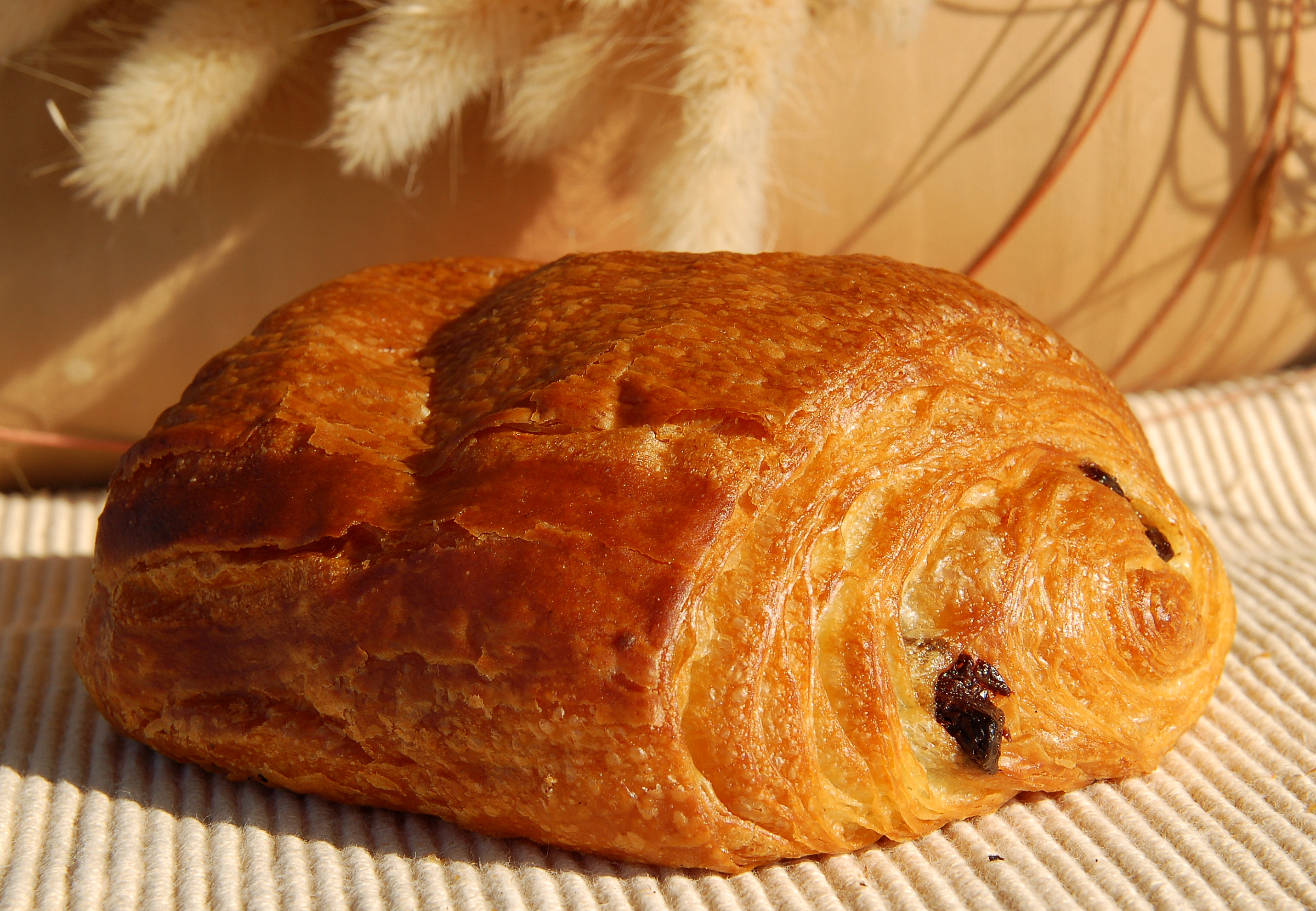
On most days, for breakfast, we usually went into patisseries (bakeries) that boasted the most buttery and wonderful croissants. It almost seemed to melt in your mouth with how warm and flaky it was. Then, there was the pain au chocolat (chocolate croissants) which were so sinful when you considered how much butter and fat is within them. The best ones I had were during my last day in Paris since I finally got one that was fresh out of the oven and the chocolate ended up being rich and bittersweet.

A pain au chocolat (photo courtesy of Wikipedia)

If possible, try to go early in the morning since French bread and pastries taste the best when straight out of the oven. Though eating them cold wasn't bad either, especially when you are consuming one while strolling down a wide Parisian boulevard.

My favorite thing, and I have a feeling, my travel mates as well, food-wise was the brasseries (creperies). These were open stands attached to cafes that sold crepes to go for upwards of 2 euros. And in 5 minutes, you had a warm, buttery, sweet, and amazing crepe in your hand, wrapped in a napkin, that you can take with you as you walked along the Seine (and yes, I did that and it was incredible). Of course, the variations available were a bit on the simple side, usually butter or sugar, ham/egg, fromage (cheese), or nutella (a hazelnut and chocolate spread), but they were still a good value for the price. What's so bad about getting filled up on chocolate?


An idea of what crepes look like (I made these back when I was at home)


If you want a fancier crepe with a variety of toppings, then going inside the cafe is usually the best idea (you don't want to carry a loaded crepe around, it can get very messy). One night, I had a crepe with chocolate sauce, vanilla ice cream, bananas, and chocolate liquer. I couldn't get a picture of it because I dived in too fast but suffice to say, it was the perfect ending to a meal.

The cheapest food in Paris was on the side streets. There, the cheapest (price-wise) food could be found. We spent a copious amount of time in the Latin District, a small area especially for college student.


Located south of the Notre Dame, near the Seine, we spent most nights looking for dinner there, if only because so many restaurants offered set menus for only 10 euros, which is usually less expensive than ordering á là carte. Though beware of the hecklers outside of the restaurant, they will try to get you to come inside their restaurants, most of the time, just look away and say "no" if you don't like the menu.

Despite that, for 10 euros in France, you could get a 3 course meal, which included appetizer, entree, and dessert. Dinner was heaven and when accompanied by red wine, I savored every bite of it. Usually dinner lasted about 3 hours since we'd end up engaged in long discussions while the waiters were slow to bring out of the food. Everything moves slower in France, especially when you're eating. After all, food is meant to be savored and dinner is the biggest meal of the day. I can't say anything more, just look at the pictures.


Mussels á là crême


Duck l'orange with baked potato (the sauce was so good, I was scrapping it off of the plate)


Chocolate souffle with vanilla custard

Contrary to popular opinion, Parisians are not very snobby at all. Understandably, they were not opening their arms in welcome but whenever I needed to speak English, they were very accommodating. Of course, it helps to speak French in Paris but it's not essential and no one's going to chop off your head if you don't. More often than not, I just ordered food in English to avoid mangling the language, especially since most restaurants had bilingual menus. It also helps if you ask them, "Parlez vous Anglais" ("Do you speak English?") before you start spewing out English, just to be polite. But otherwise, being in Paris helped me to realize just how universal English is becoming. Though the French accents still throw me since they're so thick and sometimes nearly indecipherable.

To close, being in Paris was akin to being in a dream, to coin a cliche phrase. You read about the sights in the book (or in this case, in a blog) and you see it in movies such as "Funny Face" and "Paris Je T'aime" but it's not until you are within the city itself that you are made aware of just what makes Paris so magical. It isn't just the sights or the sounds or the food, but everything melted together, the relaxed energy (except for drivers during rush hour), the history, that certain "je ne se quais" that makes it so amazing. And the crepes and pain âu chocolat? That's just the cherry on top.

Tuesday, February 17, 2009

Of Paris, the art!

Growing up Vietnamese, I have always been somewhat surrounded by a very French-influenced culture due to the fact that France occupied Vietnam for more than 60 years. A good amount of Vietnamese cuisine stems from France (such as bành xèo, a Vietnamese version of a French crepe) and after the Vietnam War, France was one of the most common countries of refuge for Vietnamese.

As a result, I have grown up with an appreciation for French culture, music, and art (made all the more potent by my father, who can speak a bit of French, and "Paris by Night," a Vietnamese variety show that was a family tradition). I grew up associating France, particularly Paris, with guitars, sunshine, the "Mona Lisa," and the Tour Eiffel. Entering college, that appreciation for the city became more fervent as I learned more about French history and art via my modern art classes. I do not consider myself a French aficionado by any means, but Paris has always been that hazy dream that was always waiting to come true.

Which is no great surprise that upon entering the city of lights, this song by a Vietnamese composer, Ngô Thụy Miên, entered my head.


"Paris có gì lạ không em?
Mai anh về giữa bến sông Seine
Anh về giữa một giòng sông trắng
Là áo sương mù hay áo em?"

Translation:
Is there anything strange about Paris, my dear?

Tomorrow I will come home through the Seine
I will come home on a white river
Will I see the white fog or your white dress?

For me, Paris is music, made all the more prominent by the amount of art and culture within the city. That is why I want to dedicate a separate post to all that makes Paris wonderful in my eyes, which is predominantly its art and, in the next post, its cuisine.

Monday, after spending a night with the Eiffel Tower, we went to the Louvre (also known as the home of infamous "Mona Lisa").


What I did not know about the Louvre was that, beside its gargantuan size which is never fully seen in movies or photographs, it used to be a palace. It was the home of the French monarchy up to Louis XIV, who decided to move to the more ornate Versailles Palace and left his collection of artwork at the Louvre. To my greatest surprise, there was indeed the foundations of the medieval Louvre Palace beneath the ground floor of the museum.


In my own incredulous words, "There's a castle in the basement?"

It would take years to really ponder every artifact within the Louvre, my travel mates and I did it in 4 hours. Yet, it was every art lover's dream with its long rows of images and artifacts. Each room is sumptuously decorated to fit the relics within it, the Grecian wing was decorate in the simple, Classical style while the more ornate French section was painted in grand, Rococo-esque (flowery and slightly over-the-top) fashion. It was almost as if the building itself was a work of art.


The French furniture room

It was also very easy to get lost in it, especially since stairways to the lobby were few and fair in between, causing you to walk down to the end of the long hallways if you wanted to exit (though I did wander into the Babylonian section of the museum by mistake, which ended up being a beautiful sight).


I spent about 3 of the 4 hours with some of the most famous artworks within human history, such as:

Jacques-Louis David's The Coronation of Napoleon

I'm the little magenta speck

The Venus
di Milo


and, of course, Leonardo da Vinci's "Mona Lisa," which amazed me with its size. How can something so small be so influential? I will never know, considering that the barrier around it was so wide, I couldn't get a close glimpse.


Then, on Wednesday, while my travel mates wandered around in the Parisian Catacombs, I decided to take full advantage of the famous art collections of Paris and go to another museum, which was closer to my heart. It is the Musee de Orsay, the Orsay Museum, and it houses modern art, dating from the 1800's to the mid 1900's. Built in an old train station, it had the most extensive collection of Realist and Impressionist art I have ever seen, even surpassing MOMA in New York, which is no surprise since most 19th century art came from Paris.


There, I spent 3 hours soaking in as much Millet, Manet, Courbet, Monet, and Renoir as I could and wishing I brought my sketchbook. In real life, the colors are so much more vivid than they are when you view them online or in reproductions. The peaceful and tranquil scenes they painted, filled with color and life, just seemed to brighten up the room. The best way to view the Monet portion of the museum (which were scattered on the ground and first floor due to chronology) is to just sit before them and let the colors soak through you.


C'est magnifique! This is one of my favorite paintings in the museum.

Alas, all good things must come to an end and at the end of that day, I had to head back to England. Yet, I feel like I still haven't completely woken up from the dream of Paris, I still recall the rooms and the feeling of awe at finally seeing Manet's "Olympia" in the flesh (no pun intended). What I wouldn't give to go back and learn from the masters...


I can only hope that one day, I'll be able to go back with my sketchbook in tow and draw to my heart's content. Ah well, c'est la vie...


P.S. And since we are on the subject of artwork, I would just like to take a moment to plead with anyone who ever goes to museums to turn off your flash when you are taking the picture. I saw an endless number of people snapping pictures of the Mona Lisa and her companions using a flash, which angered me to no ends. Not only do you not get a good picture from it since it overly intensifies the color, you also ruin the paintings/sculptures. The heat in the flash breaks down the color pigmants and the material of the paintings. So unless you dont want the famous "Mona Lisa" or "Olympia" to be available to your great-grandchildren and their offsprings, turn off your flash. I am going to get off my soapbox now.

Of Paris, the sights!

So I'm very aware that I missed updating this blog last week and have loads of entries to add. This one will be about Paris. Yes, you heard right, I spent 4 days in Paris last week from the 7th to the 11th and it was amazing. How did I find the time away from my studies to go on this adventure?

Reading week (or Spring Break part 1 for me)!

Another quirky aspect about studying at the University of Warwick is the emphasis placed on self study. The result? An English college invention known as Reading Week where students are able to catch up on their books, perfect their essays, or have another excuse to be lazy (and from what I saw of my flatmates, no one actually read). In the case of the international students, we traveled... And where better to spend a lazy week than to start off the first 4 days in Paris!

I arrived in Paris on Saturday, February 7th after spending a night a day in London (which consisted of strolling and taking a picture next to Platform 9 3/4, yes, I am a dork). The quickest way to get to the City of Lights is via the Eurostar, from London, which is famous for going underneath the English channel. That popping sound that accompanied the trip was a little bit disconcerting when you realize it's caused by the water pressure that's just above you. Yet, the journey only took 2 hours so if anyone is in a rush and don't mind missing the sights in between Paris or London, then it's definitely worth the money (our fare was only 60 pounds round trip since we went at a non-peak travel time, which was really cheap considering it's normally 60 pounds one way).

The city of Paris is divided up into 5 zones with the center being zone 1 and the suburbia areas taking up zones 2-5. For anyone looking to spend a couple of days in Paris, do not even think about wandering outside of zone 1 (save for a day-trip to Versailles but even then, the journey 45 minutes from the center of the city each way). Instead, look to spending 10 euros (give or take) on each famous sight and eating copious amounts of food; I am now officially addicted to crepes and nutella, especially when eating them while walking down Parisian boulevards.


The Haussmann buildings which cover zone 1 of Paris date from the 1850's. The railings along the buildings were made so that soldiers can run along buildings and shoot down insurgents. I learned that during my art history classes. I find it so incredibly amazing that the buildings are still there, complete with the wide one-way boulevards to accompany them. It was as if my art history books came to life and readings about Haussmanization came back into my head, a very surreal experience.

On Sunday morning, after spending a restful night at the Hotel Cheapbeds, we took the metro into Paris. The first sight? The river Seine. Up close, it's actually quite murky yet somehow, that didn't ruin the magic, especially considering that most, if not all of the Parisian sights we saw was located around the river.


In the center of the river is the Notre Dame, which means Church of our Lady, made famous within Victor Hugo's Hunchback of Notre Dame and the Disney movie that ensued. The cathedral, with its flying buttresses, iconic facade, and gargoyles just seemed to inspire both feelings of awe and fear. It's so hard to believe that such a beautiful piece of architecture could have been used to store cattle after the French Revolution. Mon dieu!


I almost wanted to shout "Sanctuary!" when we got to the top of the bell tower, or open my arms a la Titanic.

For anyone wanting to go up to the top of the Notre Dame, beware, it is 400 spiraling steps up and 400 down (though only 5 euros, which is not bad considering you're doing most of the work going up and down). The sense of vertigo increases dramatically when you are going down since by that point, your legs are waiting to drop off from exhaustion and the circular direction is almost dizzying. But the view? Worth the burn.


"This is la vie en rose." This picture represents Paris for me.

Then, there was the piece de resistance: the Eiffel Tower...


Which sparkles every hour and boosts its own little revolving beam of light at the top (it's like a really tall lighthouse). Apparently, according to Gregoire, a French exchange student I met at Warwick, every New Years, Parisians congregate with wine and food on the Champ de Mars (the lawn in front of the tower) and cheer whenever the sparkles go off.

Even though going up the tower was overpriced (12 euros to take the elevator up!), it doesn't change the fact that the view of the city at night was amazing to behold, made all the more romantic (and freezing) since it was snowing at that altitude. If you, like me, have never been to France before, then going up the iconic tower was a necessity. If not, it's like going to New York City and not going up the Empire State Building, you're missing the chance to experience an iconic symbol. As my travel mate Allison puts it, they can charge you as much as they want because they know you're going to go up anyway. Qui...


Monday was the Louvre, which will be another entry in itself. Afterward, it was a 45 minute straight walk from there through through the Tuileries Garden (where sadly we didn't have tea like in so many a Monet and Renoir paintings)...


to the Place de la Concorde, the site where the Jacobins guillotined many during the French Revolution, including Marie Antoinette...


down the Champs Elysee with it's myriad of commercial shops which included both a Disney Store and Louis Vuitton...


to the Arc de Triomphe. After all, Paris was a city meant for strolling and enjoying the sights around you, with the lights, sounds, and clean streets (contrary to popular opinion, people do pick up after their dogs).


"It's a triumph just walking to the arch," says a very tired Lana, one of my travel mates.

Tuesday was Chateau de Versailles, located all the way in the 4th level of Paris. It was the home of the French monarchy from Louis XIV up to the Louis XVI and Marie Antoinette and can only be described in one word: shiny. And looking at the Rococo styled rooms lined with gold, made of marble, at the luxuriously woven tapestries, at the detailed paintings at the ceiling, at the ornate light fixtures, you understand where the French stereotype of excess comes from. It's gaudy, purely ornamental and almost tacky. But is overwhelming? Definitely. I had never seen so much gold in one place. It was almost frightening.


This is where the Treaty of Versailles was signed after WWI (which subsequently led to WWII)

Then Wednesday was the Musee de Orsay for me (since I am an art geek) and the French Catacombs for everyone else, (which was basically 2 miles of underground tunnel filled with human bones).

Afterward, we met up again and wandered into the bohemian district of Montmartre (it's where the Moulin Rouge is located) a bit north of the Seine, and up to the Basilique du Sacre Coeur (the Basilica of the Sacred Heart).


We encountered some very aggressive hecklers at the front of the church, who were trying to sell us severely overpriced bracelets. The key is to walk forward, keep your hands to yourself, and ignore them, especially if you don't want to spend 15 euros on a piece of string around your wrist. Despite that and the heavy walk up the church's steps (we were carrying our luggage on our back which made the walk seem akin to a pilgrimage), the view of the city late in the day, accompanied by an impromptu concert on the church steps (with the guitarist leading a sing along of "All You Need is Love") was the perfect ending to Paris.


I couldn't ask for a better last look.

To describe Paris in one word: magic. It's history, culture, and romance all rolled into one. And four days was just long enough to get a satisfying taste of it but just short enough so you are tempted to return. I know I want to.

Look out for my next posts on Parisian art and food since they were so good, they deserve their own post.

Frenchisms:
  • Most place names in Paris are very direct, with names such as "Japanese Restaurant," "Bakery," or in our case, "Hotel Cheap Beds."